Every garage door spring in the county is counting down. Ten thousand cycles is the standard rating — one cycle every time the door opens and closes, seven to ten years at the twice-a-day pace most Prescott households keep. The break itself is loud and sudden, but the failure never is: springs telegraph their end for weeks, in plain sight and plain hearing, before the morning they let go. Here are the nine signs, from the subtle to the unmistakable.
1. The door feels heavier than it used to
You notice it in the opener first — the door rises slower, strains, hesitates. Springs lose tension by degrees, and the opener quietly picks up the difference. A door that’s “just getting old” is usually a door whose springs are at the line. Test it: pull the release with the door down and lift by hand. A balanced door rises with modest effort and holds at waist height. A heavy one is telling you the truth.
2. The gap in the coil
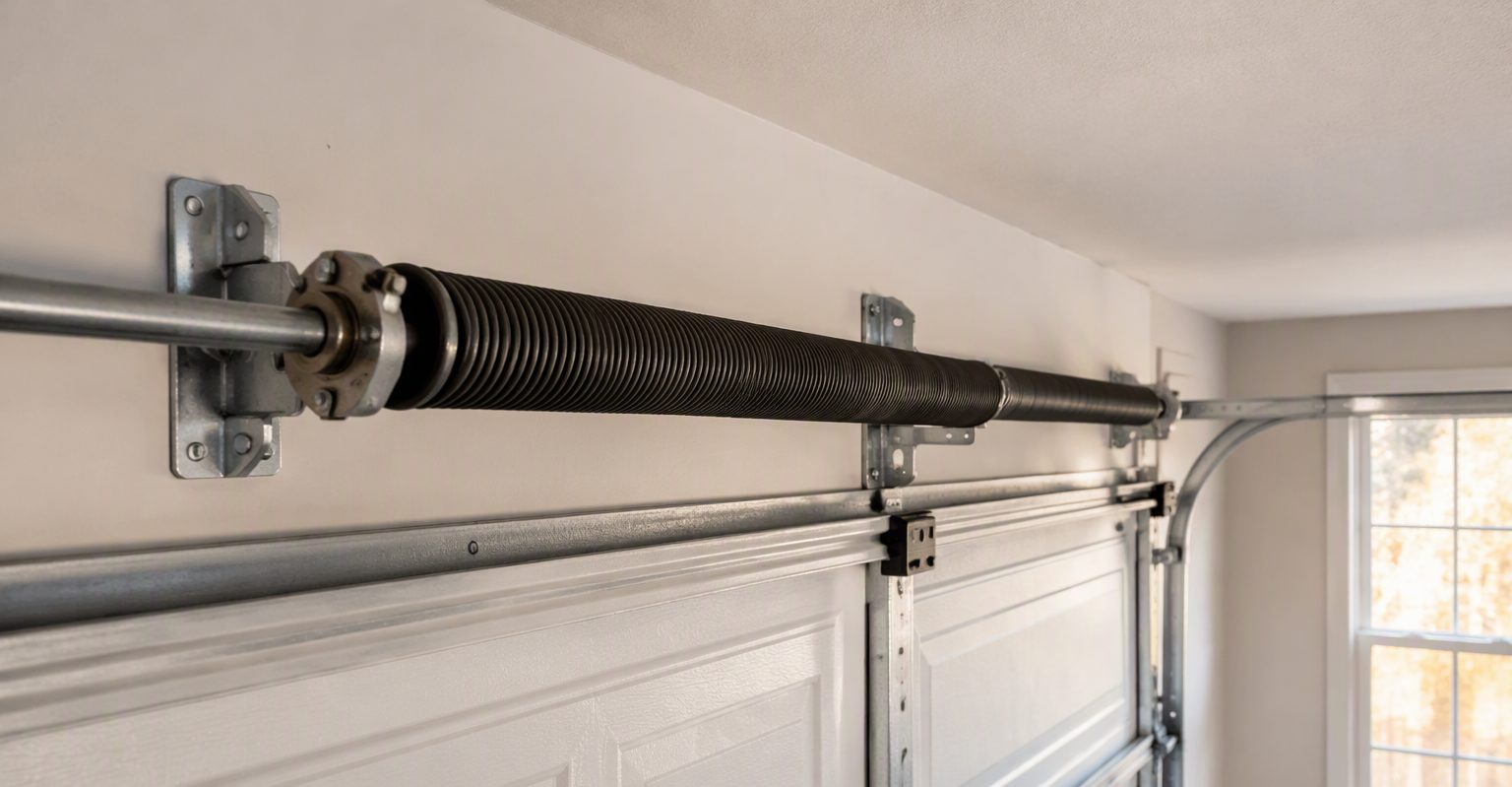
On a torsion spring — the coil on the shaft above the door — a break shows as a clean two-inch gap where the steel separated. No gap doesn’t mean no problem, but a gap is the whole diagnosis: the spring is done, the opener is dead-lifting, and the next press of the button starts stripping gears.
3. The bang in the night
Homeowners describe it as a gunshot, a two-by-four hitting the floor, a car door slamming in the garage. A snapping spring releases its stored energy in one instant, and it’s loud enough to wake the house. If you heard it and the door now won’t lift, you don’t need a detective — you need a spring swap.
4. The door opens six inches and quits
Modern openers sense the abnormal load and stop. It feels like opener failure; it’s usually the opener protecting itself from a dead spring. The motor is fine. The muscle above the door is not.
5. Loose or dangling cables
The lift cables work off spring tension. When a spring breaks or loses tension, the cables go slack — dangling down the door sides or piled on the floor. Don’t touch them; a cable under partial tension is still a whip. But do read them: slack cables point straight at the spring.
6. The crooked lift
On a two-spring door, one broken spring leaves one side lifting and one side dead. The door racks crooked in the opening — and forcing it can twist the sections and bend the tracks. A crooked door is a stopped door: leave it where it sits.
7. The shudder and the scream
A door that shudders, jerks, or screams on the way up is fighting friction and imbalance. Sometimes it’s rollers and hinges; often it’s the springs losing the smooth, even tension that makes a few hundred pounds of door feel like thirty. Noise is the door’s early-warning system — the smallest-bill conversation you’ll ever have with it is the loud one. (The biggest is the silent one that follows.)
8. Rust or scale on the coils
Look at the spring itself. Surface corrosion is friction between the coils and a weak path through the steel — monsoon humidity feeds it every July and August, and the daily forty-degree temperature swing does the rest. A corroded spring is a spring burning cycles faster than its rating. It won’t tell you when; it just goes.
9. It’s simply been that long
If the springs are original on a door that’s worked twice a day for a decade, the math has already happened. You don’t have to wait for the bang — a planned swap on your schedule beats an emergency call on the coldest morning of January, which is statistically when tired springs pick their moment up here at 5,400 feet.
When you find one
Stop using the opener — every press dead-lifts the door’s full weight through gears built for a balanced load. Keep hands and tools away from the spring itself; a wound torsion spring is the one genuinely dangerous part in the garage. Then call: springs in the common sizes ride on the truck, the swap takes under an hour, and the door leaves balanced and tested.